
Gallery (Technology)
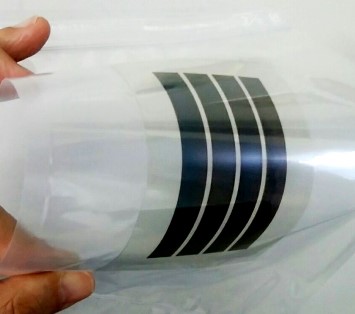 |
Perovskite film pattern printed on plastic film surface using inkjet. Film solar cells can also be produced using this printing method. This technology won the Poster Award at the 2018 Fall Meeting of the Japan Society of Applied Physics. |
 |
Mixed cation type perovskite film printed as the name of the university using inkjet. Perovskite solar cells can also be produced using inkjet printing. This technology won the Poster Award at the 2018 Fall Meeting of the Japan Society of Applied Physics. |
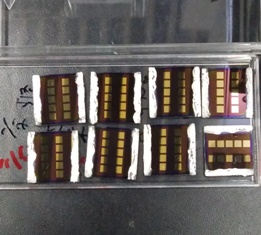 |
A measured perovskite solar cell chip was placed on the experimental bench. This is a 3mm square glass substrate coated device. November 2017 |
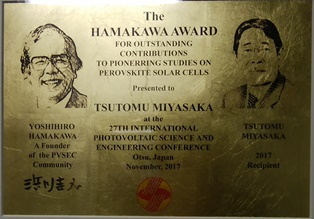 |
The 2017 HAMAKAWA Award, awarded at the PVSEC27 International Conference, was established in memory of the late Professor Yoshihiro Hamakawa, who contributed greatly to solar cell research in Japan. |
 |
A press release on perovskite solar cell technology was held on the same day as the Citation Laureate Award ceremony (October 26th), gathering members of the press: Thin film solar cells reach 18% efficiency (at Toin University of Yokohama, Center for Advanced Medical Engineering). |
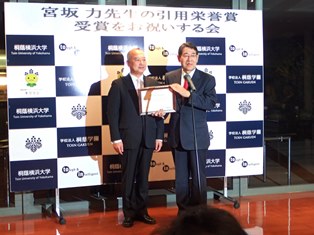 |
Clarivate Analytics' 2017 Citation Laureate Award ceremony. The event will be held at Memorial Academy, Toin University of Yokohama, from 5:30 pm on October 26th. |
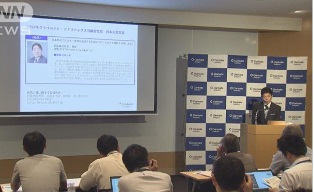 |
The Clarivate Analytics Citation Laureates for 2017 were awarded to Professor Miyasaka, Henry Snaith (Oxford University, UK), and Professor Namgyu Park (Korea), all of whom are researching perovskite solar cells. A press conference was held in Tokyo on September 20th. As Professor Miyasaka was on a business trip overseas, Associate Professor Ikegami attended and gave an explanation of their research. |
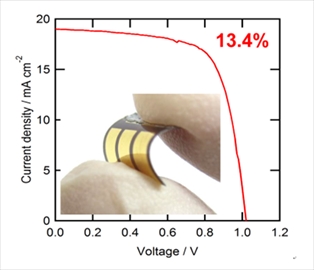 |
Perovskite solar cells fabricated on thin plastic films to make them lightweight and flexible also have an efficiency of over 13%. |
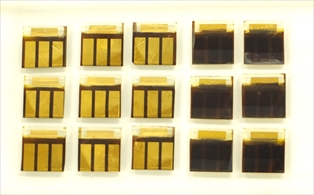 |
The film-making and assembly processes for the fabrication of MAPbI3 perovskite cells have been finalized, and it has become possible to ensure stable performance. The photo shows one batch of test cells fabricated with a film of MAPbI3. |
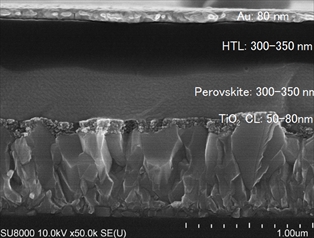 |
An example of a cross-sectional SEM image of a planar solar cell with a perovskite crystal layer (MAPbI3). A beautiful image of a continuous and uniform perovskite layer. |
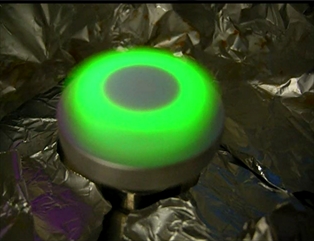 |
Strong luminescence from a thin crystal film of bromide perovskite crystal (MAPbBr3) (on a porous alumina film under UV light excitation). This was published in a 2012 paper (Chem.Lett.2012, 41, 397-399), and the number of citations increased. |
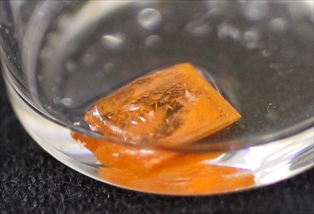 |
An example of single crystal particles of bromide perovskite crystals (MAPbBr3) formed from solution. Dr. A. Kojima made and photographed this around the time when perovskite solar cells were first made (up to 2006). This is the original perovskite crystal. |
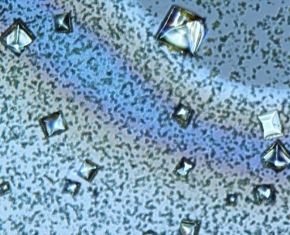 |
Single crystal particles of photosensitive material perovskite (alkylamino lead bromide) are formed on a substrate by spin coating. |
 |
Crystal particles of photosensitive material perovskite (alkylamino lead iodide) are formed on a substrate by spin coating, forming a secondary structure of aggregates. |
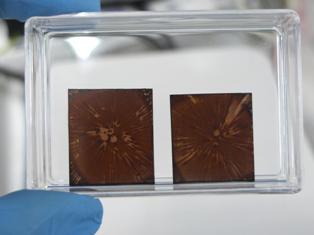 |
An example of a solid thin film of perovskite (alkylaminolead iodide), on a glass substrate, absorbing visible light up to 800 nm and coloring brown. |
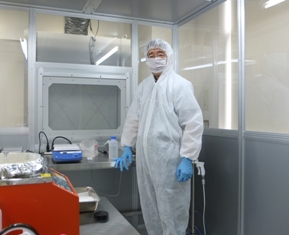 |
A scene from the Toin Laboratory at the University of Tokyo's Research Institute for Advanced Science and Technology. The power generation layer of a perovskite solar cell is formed in a clean room. June 2012 |
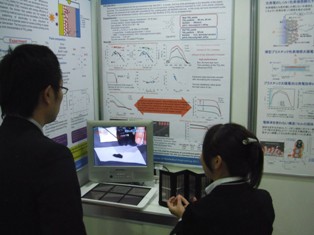 |
Miyasaka Laboratory's low-temperature deposition technology for dye-sensitized film solar cells was shown at PVJAPAN in 2011 with a poster and video at their booth. An actual portable module (foldable) using this technology was exhibited. December 5, 2011. |
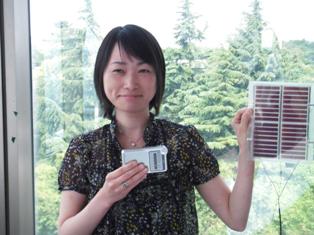 |
#6259 In the About article in the July issue of DIME (2011), this is the photo of a small film solar cell powering a small radio in the hallway in front of the laboratory. It's a shame that you can't hear the sound in the photo, but the radio works with this light. |
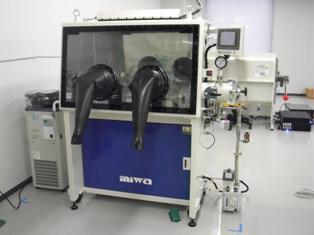 |
The new glove box, which arrived at the FIRST program laboratory on the 5th floor of the KOL building at the University of Tokyo, is full of features and has satisfied researchers (March 2011) |
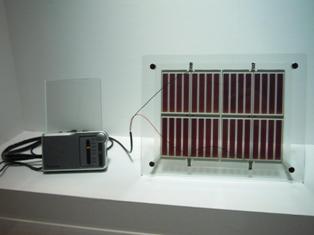 |
A full-plastic DSC module from Pexel exhibited at the 2011 PVEXPO exhibition, was demonstrated by switching on a radio and playing music under indoor lighting. |
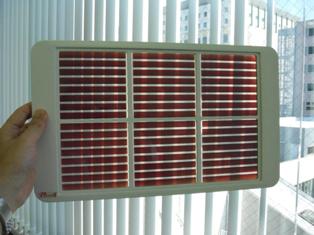 |
The smartly designed prototype all-plastic DSC module by Pexel was unveiled at the 2011 PVEXPO exhibition. |
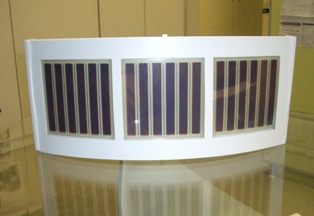 |
A film-type dye-sensitized solar cell module made with organic dyes (non-Ru complexes) as sensitizers, exhibited at PV JAPAN 2010 in July 2010. |
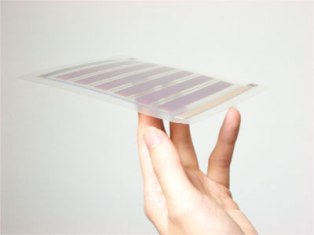 |
A 0.5mm-thick film-type dye-sensitized solar cell module (10x10cm) developed by Pexel, from the Pexel homepage. |
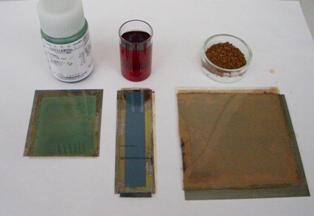 |
Three dye-sensitized solar cells made with natural dyes. From the left, a chlorophyll-sensitized solar cell (plastic type), a solar cell sensitized with red wine (glass type), and a solar cell sensitized with commercially available coffee (plastic type). In all cases, the solar motor rotated under sunlight. Red wine is thought to contain anthocyanin pigments. The coffee solar cell was also introduced on a TV Asahi variety show (May 30th). |
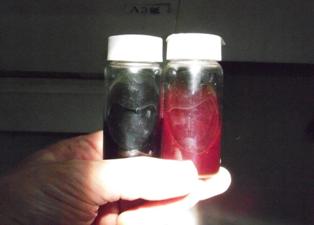 |
Photos of the luminescence (fluorescence) from chlorophyll extract. On the left is commercially available sodium copper chlorophyll phosphate (water-soluble), and on the right is an emulsion of natural chlorophyll (Mg complex). Both are green, but when exposed to light, natural Mg chlorophyll emits intense light. The deep red color of the luminescence (670 nm) is close to the color of blood and is called blood red beauty. Water-soluble |
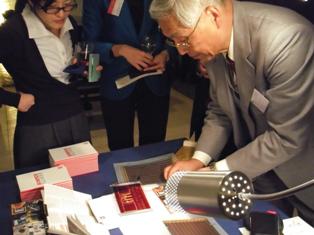 |
Professor Yanagida of Osaka University tests the photovoltaic performance of a dye-sensitized solar cell before exhibiting it at the Swiss Embassy in Azabu, March 2, 2010 |
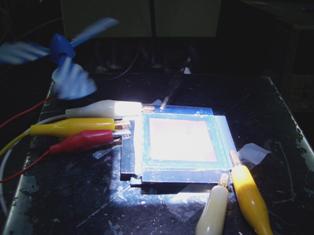 |
Photocapacitor generating electricity, simultaneously storing electricity and driving a fan. However, this element is not a typical glass substrate type, but a thin flexible type using a plastic substrate (made by Yamamoto-kun in the lab). |
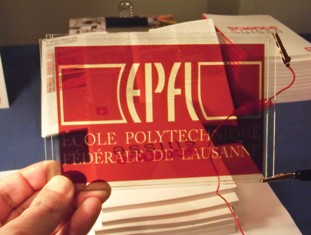 |
Dye-sensitized solar cell (glass type) with the logo of EPFL, Switzerland, brought by Professor Gratzel, at the Swiss Embassy, ??March 2, 2010 |
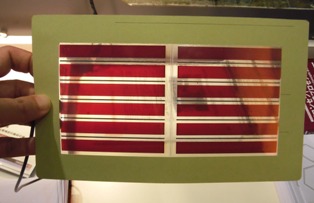 |
Fully plastic film-type dye-sensitized solar cell (using organic sensitizing dye) developed by Pexel, March 2010 |
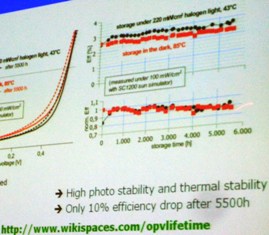 |
On July 4, 2009, the JSPS 175 Committee (Toki Messe) invited a talk by Dresden University of Technology in Germany, presenting data on the durability of phthalocyanine organic solar cells. A long lifespan of 4000 hours! |
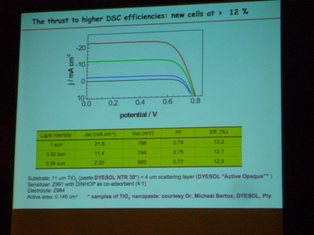 |
DSC efficiency is now in the 12% range, the same as a-Si! (Glass-type cells). Professor Gratzel gave a presentation at the DSC-IC International Symposium held in Nara on April 23, 2009. |
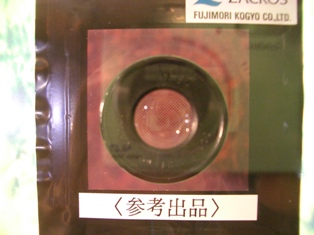 |
Structure of transparent plastic electrode for DSC with low resistance (sheet resistance 1Ω or less) (disclosed at PV-EXPO 2009 (February 25-27, Tokyo Big Sight)) |
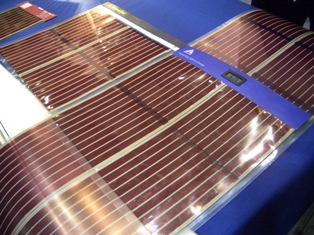 |
Washable flexible organic solar cell from Konarka, USA, photographed at PV-EXPO 2009 (February 25-27, Tokyo Big Sight). The challenge attracted attention, but the voltage was quite low under indoor lighting. |
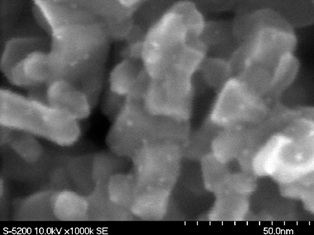 |
The surface of TiO2 particles sensitized to visible light by depositing nano quantum dots of perovskite. Achieved energy conversion efficiency of 3.8% as a solar cell (Kojima et al., JACS Bulletin) |
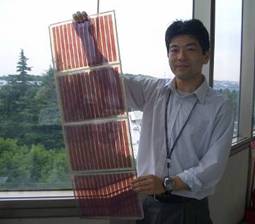 |
A typical light-transmitting (double-sided power generation) film DSC module |
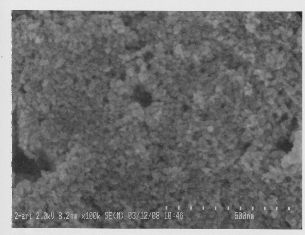 |
A well-necked nanoporous film of titanium oxide. Low-temperature film formation sample for plastic substrates (published in J. Electrochem. Soc., 004) |
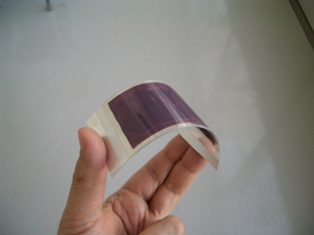 |
Solid-state plastic dye-sensitized solar cell made from carbon composite material |
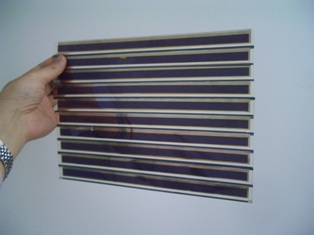 |
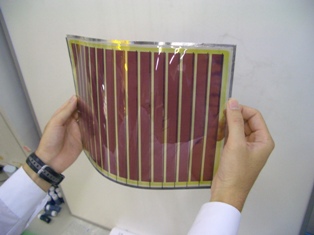
The latest full-plastic DSC module prototyped in December 2006. Achieved 4% energy efficiency (highest efficiency for a module). Improved current collection structure with 10 cells in series. |
 |
Large-area, see-through, full-plastic DSSC |
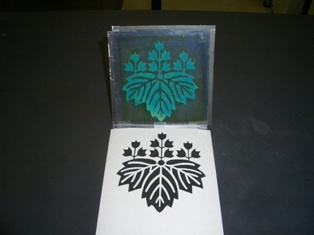 |
The university emblem has been turned into a plastic electrode. Below is the design plate used for patterning, and above is an ITO-PEN electrode made with blue organic dye. |
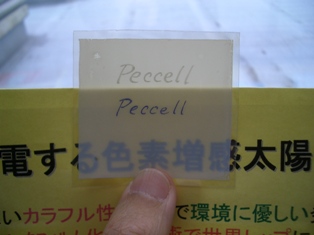 |
A titanium oxide-coated plastic electrode strong enough to write on with a pencil and ballpoint pen. The see-through nature is a characteristic of titanium oxide nanoporous membranes. |
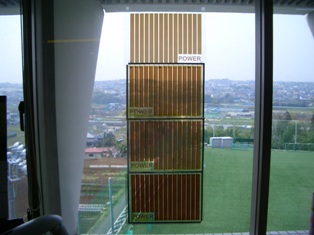 |
Dye-sensitized full plastic solar cell made using printing technology. The upper part is a light color (reduced amount of titanium oxide coating), and the lower part is a dark color (increased amount of titanium oxide coating). |
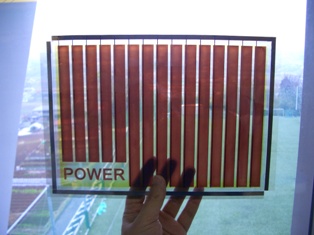 |
A dye-sensitized full plastic solar cell with the word POWER printed on it. Of course, the word POWER also generates electricity. |
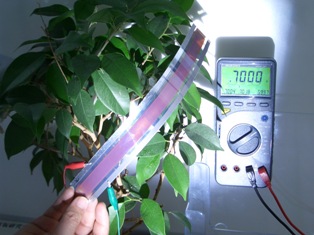 |
Single flexible DSC cell, 0.7V under indoor light |
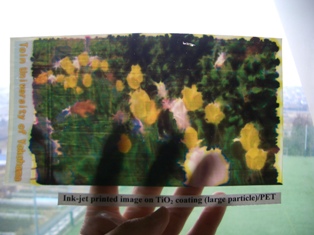 |
See-through film TiO2 sheet with a pattern created with an inkjet printer (Epson), the pattern is a flower bed on campus photographed with a digital camera |
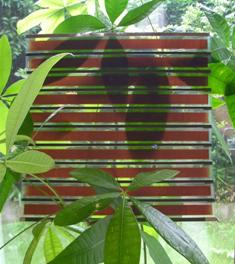 |
See-through film DSC module that blends in with the greenery, absorbing green light and allowing the red light to pass through for use in photosynthesis |
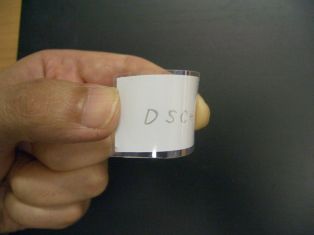 |
Binder-free low-temperature coating film (on PEN film) with increased scratch resistance to the point where you can write with an HB pencil See-through module The third 10-cell serial see-through module with a size of 30 x 30 cm |
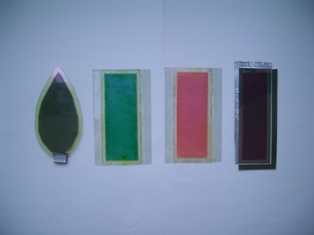 |
Colorful and flexible film DSC with outstanding artistic design |
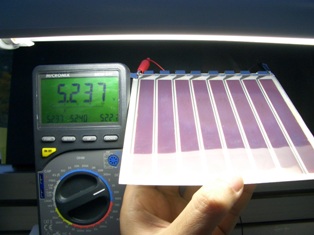 |
The original small film DSC module with 8 connected cells (15cm x 15cm), announced in September 2004 |
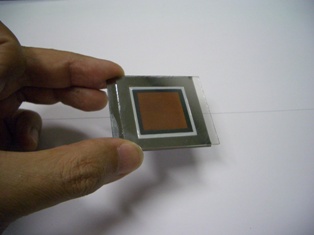 |
DSC that can store electricity with light, "light capacitor" is an original element named by Miyasaka Laboratory |
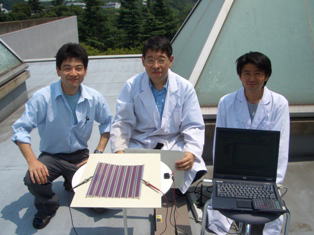 |
Testing power generation under sunny skies using film solar cells on the university roof |
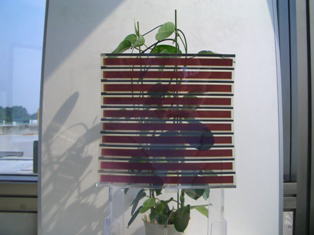 |
See-through film DSC module |
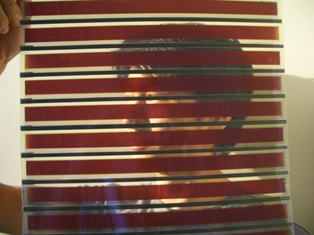 |
See-through film DSC module (model is Dr. Teshima) |